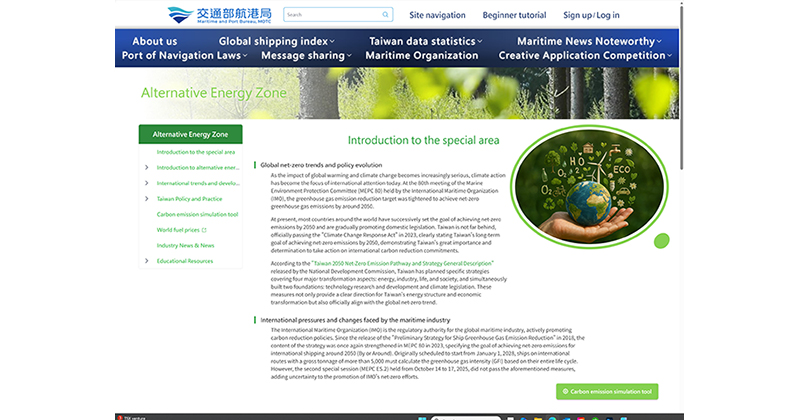
December 15, 2025 — In response to the global trend of net-zero emission reduction, the Port and Navigation Bureau of the Ministry of Communications officially launched the “Alternative Energy Zone” on the “iMarine Port Development Database” this month (December), enabling the industry to effectively grasp the latest trends in alternative energy through the integration and disclosure of domestic and international maritime emission reduction information, so as to respond to rapid market changes and strengthen the forward-looking deployment of future strategies and resources.
The 80th session of the International Maritime Organization (IMO) Marine Environment Protection Committee (MEPC 80) also set a goal of achieving “zero” greenhouse gas emissions by 2050 for ship greenhouse gas emissions. In view of this, countries have invested resources to actively explore various emission reduction technologies, and the development of alternative fuels for ships is an important link affecting the global maritime emission reduction process. In order to help the industry grasp trends and deepen awareness of emission reduction, the Port Authority has specially planned to establish an “Alternative Energy Zone” to provide a complete and interactive alternative energy knowledge base.
The Port Authority explained that the “Alternative Energy Zone” covers 7 major topics, among which the “Alternative Energy Introduction” guides users to quickly understand the current important types of alternative energy in a concise manner; “International Trends and Developments” presents global emission reduction policies, technological evolution, and changes in the international market; “Taiwan Policies and Practices” reveals domestic maritime carbon reduction strategies, government promotion achievements, and industrial green layouts; “World fuel prices” are conducive to the industry to assess operating costs and develop energy strategies; “Industry Dynamics and News” is a convergence field for the latest market information and international events; “Educational Resources” integrates relevant seminars and course information from home and abroad to promote the maritime industry’s ability to cultivate sustainability issues. Users can simulate the changes in fuel consumption and carbon emissions of 9 fuels based on the selected (filled) vessel’s sailing distance, vessel speed, and fuel consumption rate, so as to better understand the actual benefits of alternative fuels for maritime carbon reduction and enhance the practical understanding of sustainable transformation.
The Port Authority invites all sectors to experience the latest service functions of the “Alternative Energy Zone” (https://imarine.motcmpb.gov.tw/#/alternativeenergy/intro). As the most complete and rich maritime database open to the outside world in China, the iMarine Port Development Database will continue to optimize functions in a “user-oriented” manner, and will continue to enrich the data connotation, hoping to better meet the practical needs of users, and also provide reliable backing for the maritime industry to face challenges and opportunities, and work together to create smart, low-carbon, and competitive sustainable shipping.