October 1, 2026 — Under its 2050 Vision plan, the Port of Long Beach is modernizing its facilities and operations to double its annual container volume by 2050. At the same time, it is aggressively pursuing its goal of becoming the world’s first zero-emissions port.
Thanks to supply chain partners like Duncan and Son Lines Inc., both are possible.
“On the eve of the 20th anniversary of the Clean Air Action Plan, it’s exciting to see how far we’ve come with partners like Duncan and Son Lines,” said Long Beach Board of Harbor Commissioners President Steven Neal.
“Duncan and Son has been on board with moving cargo as efficiently and sustainably as possible from the get-go,” said Port of Long Beach CEO Dr. Noel Hacegaba. “The company’s business model for moving cargo is a great example of what we can achieve when every link in the supply chain works together.”
Over the last two years, Duncan and Son has operated the ramp at Union Pacific Railroad’s Phoenix Intermodal Terminal that transfers containers between railcars and trucks. The facility gives shippers the option to move goods efficiently between San Pedro Bay marine terminals and Arizona by rail.
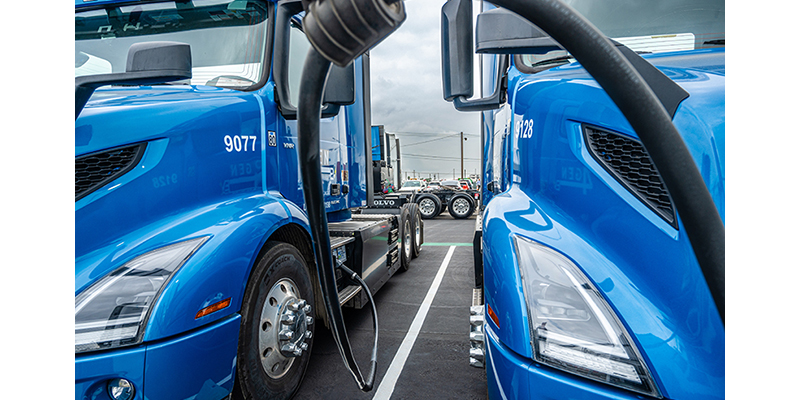
At the same time, the fourth-generation, family-owned trucking and logistics company has continued to invest heavily in zero-emissions (ZE) drayage trucks deployed at the San Pedro Bay ports and charging infrastructure to power them. By the end of this year, approximately 10% of the company’s fleet of 1,000 trucks will be ZE models.
“We want to be a leader in what we do,” said Keith Jones, Vice President of Sales for DSL Logistics Inc., the parent company of Duncan and Son, which has been serving the nation’s busiest container port complex for more than 35 years. “We certainly don’t want to be a follower. Staying ahead of the ports’ initiatives and being a good steward that facilitates trade through the port complex is where we want to be.”
The Short-Haul Rail Option
Today, trains between the ports complex and the Phoenix Intermodal Center run seven days a week, up from three days a week when the hub launched its operations in April 2024. On-dock rail connects cargo directly to and from the inland metropolis.
“We continue to see significant growth in our rail service and record volumes month over month,” Jones said. “As more shippers learn about the efficiencies and the environmental benefits, we are seeing more cargo moving between the Southern California ports and Arizona shift from truck to rail.”
Typically, inbound containers carry finished goods – furniture, electronics, clothing and shoes to the sprawling desert consumer market. Outbound cargo destined for overseas markets includes agricultural products such as alfalfa hay and raw materials such as metals and minerals. Any shipper can move cargo through the Phoenix Intermodal Center and any trucking company can provide drayage service to and from the facility.
More than 5.2 million people live in the Phoenix-Mesa-Chandler area. The region is among the top 10 most populous and fastest-growing metropolitan areas in the nation, according to the U.S. Census Bureau. Not surprisingly, the area is also home to a growing number of warehouses and distribution centers.
The first step to convincing shippers to use the short-haul rail option was letting them know the service exists. Initially, Duncan and Son marketed it directly to ocean carriers, who negotiated a rate for the service because it was not covered by the standard inland point intermodal (IPI) agreement. Today, the service is fully integrated to include IPI as an additional option for movement between overseas ports and the Phoenix rail ramp.
How quickly a truck can get an appointment and whether cargo can be transferred immediately from ship to rail are among the factors that determine which mode is faster and/or more cost-effective. “It’s important to have options,” Jones said. “This helps the entire supply chain run more efficiently.”
The Growing Case for Short-Haul Rail
In the near future, rail is poised to emerge as the preferred option to the greater Phoenix region. “We anticipate trucking costs will continue to increase significantly,” Jones said. “The trucking industry is facing higher fuel prices, increased regulation, rising insurance costs and tighter capacity as drivers retire or leave the business. A single train carrying hundreds of containers dilutes the impact of all these rising costs.”
Another consideration expected to favor rail is the upcoming closure of the Vincent Thomas Bridge in the Port of Los Angeles. In November, the 63-year-old span is due to close for a 16-month construction project to replace the bridge deck and upgrade traffic sensors, railings and other safety features.
“During the closure, we expect short-haul rail service to Phoenix to reduce congestion for everyone in the port complex,” Jones said.
Rail has the ability to handle volume fluctuations that trucks often struggle to meet, said Ryan Steinbach, Assistant Vice President, Marketing and Sales for Union Pacific. “It also provides savings. Customers avoid having to pay PierPass charges and clean truck fees to get their goods to market.”
ZE trucks are exempt from the Clean Truck Rate. Shippers pay a fee to use the Alameda Corridor, the 20-mile-long below-grade freight rail expressway that connects on-dock rail to the transcontinental rail network.
Union Pacific has seen volume more than double since it started Phoenix Intermodal Terminal as a pop-up hub more than two years ago, Steinbach said. To meet the growing demand, Union Pacific is adding more tracks. “We are currently wrapping up an expansion project that will double our working capacity with room to grow,” he said.
Union Pacific has another short-haul intermodal hub in Washington state. Also opened in 2024, the service links on-dock rail facilities at the ports of Seattle and Tacoma to UP’s inland facility in Wallula. The location is a gateway to southeastern Washington’s growing Tri-Cities region.
Clean Air Benefits
For 2026, DSL Logistics estimates the rail service linking the ports to Phoenix will reduce carbon emissions by more than 30,000 metric tons.
On-dock rail to Phoenix reduces greenhouse gases, which includes carbon emissions, as much as 75% and helps customers meet their own sustainability goals, Steinbach said. To help beneficial cargo owners calculate the environmental benefits of choosing rail, UP offers a Carbon Emission Estimator on its website.
“The combination of scalability, savings and sustainability is very important to our customers. They look at them all concurrently in order to make the decision to move cargo via rail,” Steinbach said.
In 2025, UP honored DSL Logistics Inc. with its Sustainability Partner Award. The company was one of 16 customers and suppliers UP recognized for their commitment to environmental stewardship and sustainable business practices.
Green Fleets
An early adopter of ZE trucks, Duncan and Son has invested millions in zero-emission trucks. The company currently operates 79 ZE trucks – mostly battery-electric models – and is adding another 20 to its fleet by year’s end.
All are dedicated to the region that connects the San Pedro Bay ports with Southern California warehouses, distribution centers and consumer markets. They are also deployed along the new 125-mile Green Truck Corridor to Mexico the Port announced in June. “They basically stay in California. They currently don’t have the battery range to go much farther,” Jones said.
The remainder of Duncan and Son’s fleet, approximately 900 trucks, serves much of the Southwest and urban centers beyond like Memphis. All are the cleanest available diesel models with an average age of less than three years old, Jones said.
The company’s fleet composition reflects the industry reality that a new ZE truck costs three to five times more than a new clean diesel model. The Port’s Voucher Program helped Duncan and Son purchase 68 ZE trucks, the majority of its ZE drayage fleet.
“The incentives don’t cover the entire cost differential, but they help shrink the gap,” he said. “Without them, no one in our industry would be able to afford so many ZE trucks.”
Hurdles and Opportunities
In concept, motor carriers embrace the idea of clean trucks. But the realities of more expensive models, higher insurance costs and performance challenges due to the heavier weight of ZE trucks and their shorter range with limited availability of high-speed charging stations have slowed the transition. Trained technicians and service centers to maintain ZE trucks are also limited.
“For Duncan and Son to convert 10% of its fleet to ZE models is huge. In addition to procuring the trucks, that’s a lot of money the company is spending on ancillary costs to support them that smaller guys can’t afford,” said Robert Loya, CEO of the Harbor Trucking Association, a coalition of motor carriers serving the West Coast ports. “Even if a small operator buys a new ZE model with a grant, they have to pay or finance the balance of the purchase price along with the federal excise tax and insurance based on the total amount of the truck.”
For that reason, HTA is advocating for the California Air Resources Board (CARB) to offer its Clean Truck and Bus Voucher Incentive Project (HVIP) and California Clean Fuel Reward (CCFR) programs to motor carriers without funding restrictions based on fleet size. Smaller fleets of 20 trucks or less are eligible for more funding than larger fleets, and the largest fleets are subject to additional requirements.
“Many fleets with 20 trucks or less still can’t afford to convert, and with the stacking restrictions it’s harder for larger fleet companies with more trucks to take advantage of these programs,” Loya said. “If you’re a small guy with less than 10 trucks and two of your trucks go down, that’s a significant percentage of your fleet.”
CARB continues to allow some buyers to “stack” or add port vouchers to state incentives to cover up to 90% of the purchase price of a new ZE truck. But with the current market volatility and geopolitical instability, the investment has become a harder sell, Loya said.
“A big guy is in a better position to absorb tariffs and fluctuating cargo volumes. A smaller guy will struggle to transition to newer technology with so much instability in the market. The rising price of fuel alone isn’t enough to sway carriers to replace their diesel trucks.”
Carriers like Duncan and Son are leaders in a space where market conditions are only starting to catch up to the vision, Loya said. Promising developments include the availability of Tesla and Windrose battery-electric Class 8 models, which can travel 400 or more miles on a full charge.
Emerging technology that allows operators to swap out internal combustion engines for a battery-electric motor may also accelerate the transition to ZE models, HTA’s CEO said. “It’s an important option for many carriers who had already invested in cleaner diesel models. This way, they can get the fully depreciated value out of their trucks.”
Unfortunately, CCFR incentives are only available for new vehicles and cannot be used for repowering or conversions, Loya added. “One size doesn’t fit all. The market needs all available options to facilitate and encourage the transition to zero emissions.”
New Reward and Incentive Programs
Currently, the Port of Long Beach is prioritizing using Clean Truck Fund revenue for incentives that help existing ZE truck operators stay in business. The revenue comes from $10 for each loaded twenty-foot equivalent (TEU) container hauled by trucks with an internal combustion engine, typically diesel, to and from Port terminals.
Duncan and Son is among 43 trucking companies eligible for the Port of Long Beach’s Zero-Emission Truck Early Leaders Award. Announced in June, the Port is offering a one-time payment to trucking companies who were among the first to adopt and deploy ZE trucks in Port service and who continue their use through the end of 2026.
Trucking companies that averaged 51 to 200 trips per zero-emissions truck between January 2024 and December 2025 to Port of Long Beach terminals are eligible for up to $8,000 per truck. Those that averaged 201 or more trips per zero-emissions truck during this period are eligible for up to $10,000 per truck.
Payments are expected to be made in early 2027 to companies that meet all criteria.
Also, under new measures added to the Cooperative Agreement between the San Pedro Bay ports and the South Coast Air Quality Management District, the ports are putting another $40 million into the region’s ZE truck charging network and developing additional incentives for ZE trucks deployed in port service.
Incentives are crucial to transitioning the drayage fleet to ZE models, said Loya. “The ports really have put their money where their mouth is. We’re very grateful for all they’ve been doing.”
In September, the ports issued draft guidelines for a proposed per-trip incentive for qualifying ZE trucks. The proposed Zero-Emission Truck Rewards Incentive Program, or ZE-TRIP, seeks to make ZE trucks more cost-competitive, encourage greater use of them and increase their numbers in port service.
The ports are considering a three-year program with incentives of $60 per terminal visit capped at $36,000 annually per vehicle. The draft guidelines are available for public review on the San Pedro Bay Ports Clean Air Action Plan website. Comments may be made online through 5 p.m. Monday, Nov. 2, at cleanairactionplan.org/strategies/ze-trip-form or by email at trucks@cleanairactionplan.org.
Infrastructure
To support its ZE fleet, Duncan and Son’s sister company, 4 Gen Logistics LLC, has invested in charging infrastructure in partnership with Electrify America. The latter, primarily owned by Volkswagen Group of America, was established to develop an electric vehicle charging network throughout the U.S.
In November 2024, 4 Gen opened a heavy-duty truck charging depot with 30 high-speed chargers in the heart of the port complex at 200 Pier S Ave. in Long Beach. By then, 4 Gen was also operating a similar depot with 14 high-speed chargers in Rialto, California. The site is a critical connection on the busy freight corridor linking the San Pedro Bay ports to Inland Empire consumer markets, warehouses and distribution centers.
4 Gen is moving forward with the second and final phase of building out both charging stations. In Long Beach, the company is adding 30 more high-speed chargers for a total of 60. In Rialto, 4 Gen is adding 16 additional chargers for a total of 30. 4 Gen plans to complete the project by mid-2027.
The existing chargers repower Duncan and Son’s battery-electric trucks from 20% to 80% in about 90 minutes. As part of the second phase, 4 Gen’s infrastructure will include 10 megawatt chargers with pull-through lanes. The combination will allow trucks to pull straight in, recharge in about 20 minutes and pull straight out, Jones said.
“When we finish Phase 2, 4 Gen will be among the largest heavy-duty truck charging facilities in North America with possibly the most pull-through megawatt charging lanes in the industry,” Jones said.
Faster charging ensures more turns, which motor carriers need to get a return on their investment in ZE trucks, Loya said. “With the original commercial charging systems, it would take four to six hours to repower a truck. When you take into consideration a driver’s hours of service, sitting around waiting for the truck to charge isn’t optimal from an operations perspective. It’s not sustainable.”
The Long Beach and Rialto stations currently support Duncan and Son’s fleet and are not open for general use. However, 4 Gen has agreements with other trucking companies to use its charging facilities if they have power issues at their locations. When the sites are completed, both locations will be open to other carriers that have agreements with 4 Gen. “The agreements are needed because both charging depots are fenced in and secure,” Jones said.
The Big Picture
During July 2026, 613 ZE trucks called at the Port of Long Beach. The number represents nearly 3.6% of the 16,853 drayage trucks with access to San Pedro Bay port terminals. Of these ZE trucks, 510 are battery-electric and 103 are hydrogen fuel cell models.
While hydrogen-powered Class 8 trucks have a longer range than their battery-electric counterparts, investing in them has proven tricky. Two of the first three manufacturers whose hydrogen models were eligible for state vouchers went bankrupt. Additionally, there are fewer places for hydrogen trucks to refuel and availability of the fuel itself has been unreliable. Currently, of the 20 tractor models eligible for state vouchers, 19 are battery-electric and only one is hydrogen-powered.
Meanwhile, significant progress has been made on ZE truck charging infrastructure since November 2022 when the Port dedicated its first public charging station for electric-powered heavy-duty trucks. Today, 4 Gen’s facilities are part of a larger network of more than 200 charging units open or under construction within the Port of Long Beach. More are located along Southern California’s freight corridor. Many of these charging units are also being upgraded to megawatt chargers, enabling more ZE trucks to charge more quickly and allowing facilities to serve more ZE trucks.
Modernizing the drayage fleet and expanding the infrastructure that keeps clean trucks on the road are part of the larger progress the Port and its partners are making to ensure the maritime, international trade and transportation industries are prosperous and sustainable.
Since 2005, the Port has seen container volume rise 44% while cutting emissions of diesel particulate matter 90%, nitrogen oxides 68% and sulfur oxides 98% from all port-related sources: ships, trucks, trains, harbor craft and cargo-handling equipment. Going forward, ports, their business partners, equipment manufacturers, technology companies, public agencies and communities will continue working together to eliminate the remaining emissions and reduce greenhouse gases that trap heat and drive climate change, Hacegaba said.
“There’s no turning back. With all our partners, we’re building the Port of the Future™ – a world-class seaport where commercial success and zero emissions go hand and hand,” he said.