
As ports throughout the Pacific region navigate increasingly complex security challenges, the need for innovative technologies that provide real-time awareness of activity across vast operational environments has never been greater. From perimeter intrusion detection and critical infrastructure protection to marine domain awareness and operational resilience, modern ports require solutions that go beyond traditional surveillance systems.
One company helping to shape the future of infrastructure security is Sintela, a global leader in Distributed Fiber Optic Sensing (DFOS) and Distributed Acoustic Sensing (DAS) technologies. As a new associate member of the Association of Pacific Ports (APP), Sintela brings cutting-edge expertise in fiber optic sensing, artificial intelligence, and machine learning to an industry increasingly focused on safeguarding critical assets while improving operational awareness. The company is known within the security market for being selected as the Linear Ground Detection System for the US Southern and Northern Border, after an exhaustive competitive evaluation by the Department of Homeland Security. After a strong start to the program, the contract ceiling has been raised to $200m.
According to James Ashdown, Chief Operations Officer for Sintela, the company’s technology transforms ordinary fiber optic cable into an intelligent sensing network capable of detecting and classifying activity across extensive areas in real time.
“Our goal is to help operators understand exactly what is happening around their facilities and provide actionable information before a situation becomes a problem,” Ashdown said.
Building on decades of expertise
Although Sintela itself is a relatively young company, the expertise behind its technology runs much deeper. The company was founded by a team of specialists with decades of experience in distributed fiber optic sensing, acoustics, photonics, and machine learning. In describing the senior leadership, Ashdown noted that they had recognized an opportunity to advance traditional sensing technologies by combining them with sophisticated artificial intelligence and event classification algorithms.
Today, Sintela operates internationally with hubs in the United Kingdom, United States, and India. The company reports that its ONYX™ sensing platforms have been deployed on assets covering more than 55,000 kilometers worldwide, supporting applications ranging from border security and critical infrastructure protection to rail networks, pipelines, subsea monitoring, smart cities, and environmental research.
The company’s flagship ONYX™ platforms are designed to convert existing telecommunications fiber into powerful sensing networks capable of detecting vibrations, acoustic signals, and disturbances over long distances. Rather than requiring specialized fiber installations, Sintela’s systems utilize standard telecommunications fiber, significantly reducing deployment costs and complexity.
Turning fiber into intelligence
At the heart of Sintela’s technology is distributed acoustic sensing, a method that allows fiber optic cable to function as a continuous sensor.
The concept is remarkably simple yet extraordinarily powerful. Every vibration creates a unique acoustic signature. By analyzing amplitude, frequency, and phase characteristics, Sintela’s systems can determine not only that an event has occurred, but what type of event it is.
“We don’t just see an alert,” Ashdown explained. “We’re looking at the characteristics of the signal and determining whether it’s a person climbing a fence, someone digging, a vehicle idling near a perimeter, or simply wildlife moving nearby.”
The company’s AI-powered algorithms have been trained using extensive real-world data collected across multiple industries. This enables the system to distinguish meaningful threats from routine environmental activity, dramatically reducing nuisance alarms while improving detection accuracy. The result is a level of situational awareness that traditional perimeter security technologies often struggle to achieve.
A natural application for ports
While Sintela’s technology has already been widely adopted in sectors such as border security, pipelines, rail transportation, utilities, and data centers, Ashdown believes ports represent one of the most compelling applications for distributed acoustic sensing.
Modern ports encompass large geographic footprints that include fences, terminals, container yards, roadways, rail corridors, waterfront infrastructure, and marine approaches. Monitoring these areas effectively presents a significant challenge.
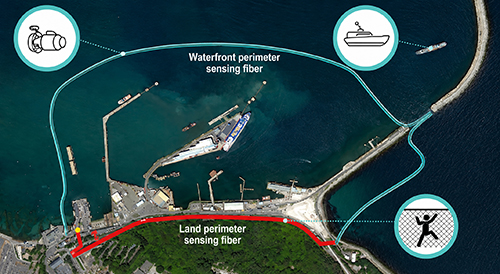
Using a single fiber optic network, Sintela’s technology can detect fence climbing, cutting, digging, vehicle activity, and other potential security incidents across an entire perimeter. Because the system continuously monitors the full length of the fiber, operators gain immediate visibility into where activity is occurring and what type of event is taking place.
For ports concerned about waterfront security, the technology offers additional possibilities. Fiber deployed near marine environments can detect vessel movement, engine activity, and other disturbances, providing another layer of information that complements radar, cameras, and other marine surveillance systems.
“Ports already have many security systems in place,” Ashdown said. “What we’re providing is another source of intelligence that can help operators make better decisions.”
Seamless integration
One of Sintela’s strengths is its ability to integrate with existing security and operational platforms.
The ONYX™ systems support open architectures and can connect with video management systems, access control platforms, physical security information management systems, and other operational technologies through standard interfaces. Ashdown added that its software architecture supports integration through REST APIs, Modbus, SNMP, and other industry-standard protocols.
For ports that are increasingly moving toward centralized operational command centers, this interoperability is particularly important. Rather than replacing existing investments, Sintela’s technology enhances them by providing another layer of real-time information that can be incorporated into a unified operating picture.
ONYX™ Nano and ONYX™ Peta
Sintela currently offers two primary distributed acoustic sensing platforms.
The ONYX™ nano is a compact, low-power system capable of monitoring up to 20 kilometers of fiber from a single unit. Designed for shorter-range applications, it occupies only one rack unit and consumes approximately 40 watts of power while still delivering advanced detection and classification capabilities.
For larger deployments, the ONYX™ peta provides monitoring capabilities extending up to 130 kilometers. The platform incorporates advanced sensing, processing, and AI-driven analytics within a compact three-rack-unit enclosure and is capable of monitoring extensive infrastructure networks from a single location.
Both systems are designed for high reliability, low power consumption, and seamless integration into existing operational environments.
Looking ahead
As security concerns continue to evolve, Ashdown sees significant opportunities for ports to leverage distributed acoustic sensing as part of a broader strategy for infrastructure protection and operational resilience.
The technology’s ability to classify events, reduce false alarms, and integrate with existing systems positions it as a valuable tool for ports seeking greater awareness across increasingly complex environments.
For Sintela, membership in APP represents an opportunity to engage directly with port leaders and better understand the challenges facing the maritime sector. “We’re excited to learn from APP members and explore ways we can help improve security and operational awareness across the industry,” Ashdown said.
As Pacific ports continue investing in smarter, more connected infrastructure, technologies that transform existing fiber networks into intelligent sensing systems may play an increasingly important role in protecting the gateways that keep global trade moving.