September 28, 2026 — Port Alberni Port Authority is pleased to announce that the Port Alberni Transshipment Hub (PATH) has been selected for inclusion in the 2026 Canada Investment Summit Dealbook, showcasing major Canadian investment opportunities to leading global investors.
The inaugural Canada Investment Summit, took place September 14–15, 2026, bringing together some of the world’s largest investors, Canadian business leaders and public-sector representatives. The Summit is part of the Government of Canada’s broader effort to attract significant new investment into Canada and advance major projects and infrastructure that strengthen the Canadian economy and improve the country’s global competitiveness.
“Having PATH identified by the Province as a priority investment opportunity and advanced to the federal level is an important milestone for the project,” said Zoran Knezevic, Co-CEO of the Port Alberni Port Authority. “Its inclusion in the Canada Investment Summit Dealbook provides an opportunity to introduce PATH to some of the world’s leading investors and demonstrate how this project could strengthen Canada’s Pacific trade network.”
A Next-Generation Marine Logistics Corridor
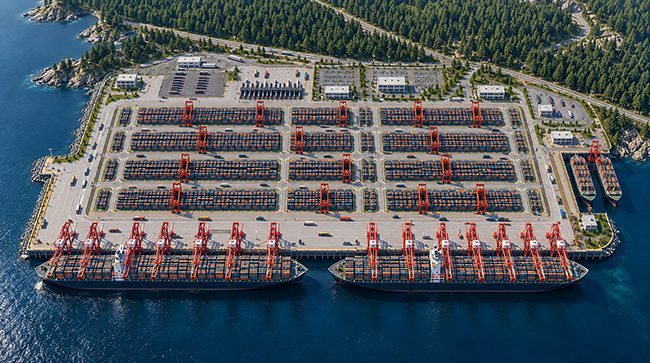
The Port Alberni Transshipment Hub (PATH) is a proposed next-generation marine logistics corridor designed to make Canada’s Pacific supply chain faster, more efficient and more resilient.
Think of PATH as a modern distribution centre for the Pacific Gateway. Rather than having every large container vessel make multiple calls at congested ports, ultra-large container vessels would make a single call at PATH. Cargo would then be sorted by destination and distributed using feeder barges and connections to regional ports, rail and trucking networks, the most efficient transportation option for each market, supporting more reliable, just-in-time delivery.
This hub-and-spoke model is designed to reduce congestion at major gateways, lower transportation costs, shorten vessel turnaround times and improve supply-chain reliability.
Rather than competing with existing ports, PATH is designed to connect them into a coordinated transportation network, distributing cargo more efficiently across the Pacific Gateway and making better use of existing regional infrastructure.
PATH would also introduce critical system redundancy by providing an additional marine gateway capable of supporting freight movement when existing trade corridors are affected by disruptions, such as , climate events, infrastructure failures or capacity constraints.
“PATH is not simply about building another container terminal,” said Mike Carter, Co-CEO of the Port Alberni Port Authority. “It is about creating a more connected and resilient Pacific trade network. By sorting cargo at the gateway and using marine transportation to move containers closer to their final destinations, PATH can add capacity while reducing pressure on congested highways, bridges and existing terminal infrastructure.”
Located in the Alberni Inlet on Vancouver Island, the proposed terminal would provide ultra-large container vessels with access to a sheltered, deep-water location strategically positioned along Pacific shipping routes.
At full build-out, PATH is envisioned with capacity of approximately five million TEUs annually. Previous project analysis has identified several of the potential benefits: PATH is envisioned to reduce congestion throughout Westcoast transportation network resulting in fewer truck, trains and ships transiting, creating a significant reduction in greenhouse emissions, road congestion and overall negative impact on the marine ecosystem, through optimized marine logistics.
Once operational, PATH is expected to generate significant long-term economic benefits through new investment, skilled employment, increased trade capacity and enhanced regional development. It would also provide Vancouver Island with a more direct connection to international trade while supporting Canada’s broader objectives to diversify trade and strengthen access to global markets.
PATH is being advanced in collaboration with Huu-ay-aht First Nations, building on a long-standing relationship with PAPA to explore deep-sea port opportunities in the Alberni Inlet.
The project is currently in the early design and pre-feasibility stage. Further technical, environmental, Indigenous engagement, regulatory, commercial and financial work will be required as the project advances.
Inclusion in the Canada Investment Summit Dealbook provides an important opportunity to introduce PATH to major Canadian and international investors and strategic partners and build the relationships required to move the project toward its next stage of development.
“Canada’s trade infrastructure needs to be built not only for today’s volumes, but for the challenges and opportunities of the next several decades,” said Knezevic. “PATH represents an opportunity to add capacity, redundancy and resilience to Canada’s Pacific Gateway while creating lasting economic opportunities for Vancouver Island, British Columbia and Canada.”
For more information, visit PATHBC.ca.