August 19, 2026 — A final push by shippers to move goods before the start of new tariffs lifted the Port of Long Beach to its second-busiest July on record, Port CEO Dr. Noel Hacegaba announced Wednesday during the latest episode of his Supply Chain Insight media briefing series.
The latest cargo numbers showed that Long Beach dockworkers and terminal operators processed 928,508 twenty-foot equivalent units (TEUs) last month, a 1.7% dip from July 2025.
Last month marked the seventh time the Port of Long Beach had surpassed 900,000 TEUs in its 115-year history, Hacegaba said, adding that shippers were preparing for uncertainty leading up to the July 24 expiration of the temporary tariff program.
Although the latest tariffs affect more than 90% of all U.S. imports, Hacegaba said he does not expect it to significantly impact trade at the San Pedro Bay ports complex.
“This capped an early peak season as companies continued to navigate tariff uncertainty, higher fuel costs and other global issues,” Hacegaba told reporters. “Our strong import numbers show that the supply chain continues to be resilient and adapting to this new normal.”
Imports were down slightly a flat 0.1% to 467,461 TEUs, while exports soared 14.8% to 104,843 TEUs year over year. Empty containers last month fell 7.4% to 356,205 TEUs.
For the first seven months of this year, the Port of Long Beach has moved 5,758,086 TEUs across its docks, 1.2% ahead of the same period in 2025.
“Customers continue to choose the Port of Long Beach for moving their cargo safely, reliably and efficiently,” said Long Beach Harbor Commission President Steven Neal. “We offer certainty in unpredictable times and customers see the value in what we can provide.”
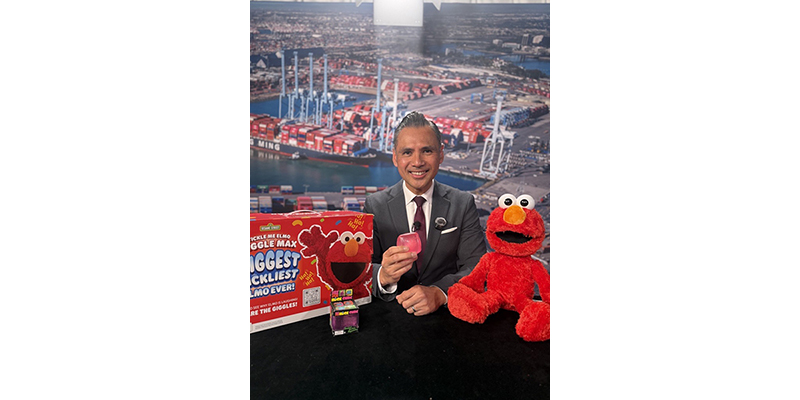
The media briefing also featured James Zahn, editor-in-chief of The Toy Book, a trade publication covering deals, trends and innovations in North America’s toy industry. Hacegaba and Zahn discussed some of the hottest toy trends for this holiday season and how tariffs and shifting trade policies have affected the toy supply chain.
Hacegaba said the Port is monitoring several factors that could influence cargo volumes in the months ahead, including global economic conditions, consumer demand, trade policies and geopolitical developments.
“Businesses can’t control trade policy, geopolitical events or energy markets; what they can control is how quickly they respond,” Hacegaba said. “That’s exactly what we’re seeing at the Port of Long Beach. Companies are becoming more resilient, more diversified and more agile. And that’s encouraging, not just for our Port, but for the broader U.S. economy.”
For the full episode of Supply Chain Insight, please click here.
For Port of Long Beach CEO Dr. Noel Hacegaba’s remarks in Spanish, please click here.