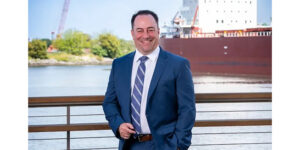

For Terry Umatum, becoming Port Director of the Don Young Port of Alaska is more than a career milestone — it is the culmination of decades spent solving complex logistics challenges, leading people through change, and ensuring critical supply chains continue to move.
Only months into the role, Umatum is already overseeing one of the most ambitious infrastructure projects in North America while maintaining uninterrupted operations at the state’s busiest cargo gateway. It is a balancing act few port leaders will ever experience.
“It’s not only about running a port,” he said. “I’m also overseeing a multi-billion-dollar modernization program while ensuring Alaska continues to receive the fuel, food and goods it depends on every single day.”
The challenge is immense, but Umatum believes his career has prepared him well to meet it.
A career built on logistics
Before joining the Port, Umatum spent more than 26 years in the trucking and logistics industry after serving in the United States Navy. Those experiences, he says, shaped the leadership style he brings to the Port today.
“The trucking industry teaches you that change is constant,” he said. “You learn very quickly that every day presents something different, and success depends on being able to adapt.”
That ability to navigate uncertainty has proven invaluable.
Construction zones shift daily. Hundreds of contractors move through the Port. Cargo schedules cannot stop simply because new terminals are being built. Every decision requires careful coordination between the Municipality of Anchorage, engineering teams, terminal operators, fuel suppliers and construction contractors.
“It really comes down to solving problems,” Umatum said. “You tackle the issue in front of you, see it through, find the solution, and then move to the next challenge.”
His time in the Navy also provided unexpected experience that translates directly to his current role. As a machinist’s mate working aboard naval vessels during the first Persian Gulf conflict, he participated in fuel operations — experience that now informs management of one of the Port’s most critical responsibilities.
Every month, tens of millions of gallons of fuel pass through the port, supplying communities across Alaska, military installations and Ted Stevens Anchorage International Airport.
Safety comes first
Despite the enormous scale of the modernization program, Umatum is unequivocal about his main priority. “Safety is number one.”
The achievement he is proudest of since arriving at the Port has nothing to do with construction milestones or funding announcements. “In 2025, we had zero recordable safety incidents,” he said. “Nobody got hurt.”
Maintaining that record while simultaneously operating a busy commercial port and managing major construction has become the benchmark against which every decision is measured.
The Port of Alaska serves 90 percent of the state’s population with about half of the consumer goods entering the state. Weekly container services operated by Matson and Tote deliver everything from groceries and vehicles to building materials. Fuel vessels, cement carriers, barges and military cargo move through the facility throughout the year.
Keeping all of those operations functioning safely while large sections of the Port are effectively transformed into construction sites requires meticulous planning.
Building Alaska’s future
The centrepiece of Umatum’s early tenure is the continuation of the Port of Alaska Modernization Program (PAMP), one of the largest port redevelopment projects currently underway in the United States.
The existing port infrastructure has served Alaska for more than six decades but has reached the end of its design life. Marine pilings continue to deteriorate from corrosion, while the risk posed by major seismic activity has become an increasing concern. “We’re beyond the life expectancy of the current infrastructure,” Umatum said. “This project is about making sure this Port continues serving Alaska for generations.”
The modernization is being delivered in multiple phases over the next decade.
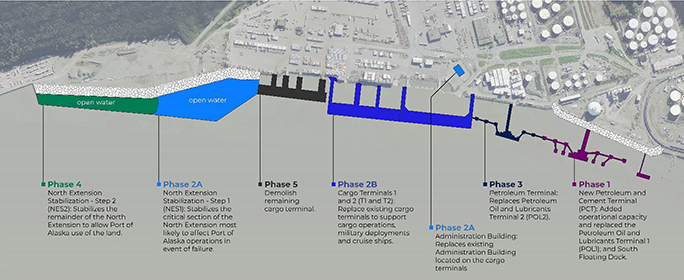
Following completion of Phase 1 including the south floating dock and the new Petroleum and Cement Terminal, work is now well underway on Phase 2A which includes the completed new administrative building at the start of construction of Terminal 1, where construction is occurring while existing cargo operations continue only metres away.
The Terminal 1 replacement is expected to be commissioned in 2028, with Terminal 2 following shortly afterwards and Terminal 3 planned later in the program.
For Umatum, one of the greatest accomplishments so far has been maintaining project momentum. “The PAMP program is on schedule according to our contactors,” he said.
Preparing for the next generation of shipping
While replacing aging infrastructure is the primary objective, the modernization also positions Alaska to accommodate the future of international shipping. Global shipping lines continue to build larger container vessels, yet the Port of Alaska’s existing cranes were designed decades ago. The new terminal will feature significantly larger cranes capable of servicing bigger vessels while reaching further into Cook Inlet to allow for greater water depth.
“The world isn’t building smaller ships anymore,” Umatum said. “When our carriers decide to upgrade and modernize their fleets, we’ll be ready.”
The modernization program is intended to preserve capacity, improve resilience and allow the port to respond to future changes in vessel size, and shipping practices. Umatum believes maintaining and even increasing capacity in some areas for future shipping trends is essential. The redevelopment also represents an opportunity to transform the way the port operates. Many existing systems date back to the 1950s and 1960s. Automation was virtually nonexistent when much of the original infrastructure was built.
That is changing. New cargo handling systems, upgraded electrical infrastructure, and digital technologies are being incorporated throughout the redevelopment. “We’re building for today’s standards and tomorrow’s requirements,” Umatum said.
Protecting a unique environment
Operating a major construction project in one of North America’s most environmentally sensitive marine ecosystems presents unique challenges. The Port of Alaska works closely with federal and state regulatory agencies to monitor water quality, air emissions and construction impacts.
Fuel handling remains one of the port’s most closely managed operations, with strict procedures in place to prevent any environmental issues at the port. Construction itself introduces additional environmental considerations, including hydraulic systems, vibration monitoring and noise management for nearby residential communities.
Perhaps the most distinctive operational requirement, however, involves one of Cook Inlet’s most iconic marine mammals. Observers equipped with powerful telephoto lenses continuously monitor the construction area for endangered Cook Inlet beluga whales. “If belugas enter the work zone, construction stops,” Umatum said. The requirement illustrates the careful balance between delivering critical infrastructure and protecting Alaska’s unique natural environment.
Finding the workforce
While funding often dominates headlines surrounding large infrastructure projects, another challenge receives less public attention — finding skilled labour. “According to our contractor, approximately 200 construction workers report to the modernization project each day, and nearly half come from outside Alaska.
“We simply don’t have enough skilled tradespeople in Alaska to support all the major projects happening across the state,” Umatum said. Contractors recruit workers nationally through union halls and specialist construction firms to meet the demands of the modernization program.
The cost of critical infrastructure
Although the modernization program has secured significant support from state and federal governments, Umatum says financing remains one of the project’s greatest challenges.
The Municipality of Anchorage has assumed primary responsibility for moving the project forward, relying heavily on municipal revenue bonds to finance construction. Those bonds must ultimately be repaid, and much of that cost flows through to the movement of cargo. Every container, every barrel of fuel and every ton of cement moving through the port contributes toward financing the redevelopment.
“The reality is that along with federal and state funding sources, Alaskans are helping to pay for this project via municipal bonds paid for / offset by port surcharges” he said, adding that because nearly everything entering the state passes through the Port of Alaska, the cost of modernization is reflected throughout Alaska’s economy.
While grateful for state and federal grant programs, Umatum believes the amounts could be more. “When you have an $800+ million project, and the grant tops out at $61.5 million, it still leaves a significant funding gap,” he said. “We are working with our congressional delegation to identify opportunities for significantly larger infrastructure funding programs that can support projects of this scale in the future.”
Looking ahead
Although Alaska’s population has remained relatively stable, several major developments could dramatically increase demand on the port in coming years.
Potential construction of a natural gas pipeline, major military investments at Joint Base Elmendorf-Richardson and other large-scale infrastructure projects all point toward increased freight volumes.
Those projects reinforce the importance of ensuring Alaska’s primary gateway remains resilient, modern and capable of supporting future economic development.
For Umatum, however, success is measured less by project milestones than by ensuring the people of Alaska continue receiving the goods they depend on every day.
His focus remains clear: keep people safe, keep cargo moving and deliver a modern port that will serve future generations.
“I’ve lived in Alaska almost my entire life,” he says. “I understand what this port means to our communities. Every decision we make here is about protecting Alaska’s future.”
As construction continues over the coming decade, the Port of Alaska stands as one of the Pacific’s most significant infrastructure investments—an undertaking that will strengthen supply chain resilience not only for Alaska, but for the broader Pacific maritime network for decades to come.